

A tennis tote is a natural choice when your court bag also comes to the office, the café or an afternoon appointment. A tennis backpack is worth considering when you want a two-strap carry for a journey with more walking or cycling. The useful comparison is how each design fits your route, how you reach your belongings and where your racquets sit.
Start with the journey you actually make. Then compare the details of the individual bag: totes can have dedicated compartments, and a detachable crossbody strap adds another carrying option beyond the handles.
Compare the three moments in your court commute
Picture your next tennis day from the front door to the first ball. These three moments reveal more about the right carrying format than a generic list of bag styles.
- On the move. How long are you carrying the bag, and do you need both hands available? Think about stairs, a station platform or your walk from the car. For cycling, check that your chosen bag and racquets remain secure and clear of your movement before setting off.
- At a stop. Which item do you reach for first: keys, a travel card or water? Look for a suitable pocket and check how you would reach it while carrying the bag.
- After play. Will you go home or continue with your day? Consider a separate place for court shoes and a silhouette you are happy to carry to the next stop.
Tote or backpack: what to check on each design
| Your priority | Tennis tote | Tennis backpack |
|---|---|---|
| Carrying options | Check the handles and whether a shoulder or crossbody strap is included. | Check both shoulder straps, their adjustment and the position of the loaded bag. |
| Racquet position | Check where the racquets sit and how they are held. | Check the sleeve, closure and position of any exposed handles. |
| Access between stops | Look at the actual opening and accessible pockets; a tote is not necessarily open-topped. | Look at which pockets are reachable and which require taking the bag off. |
| Organisation | Look for dedicated spaces, including footwear storage when you need it. | Check the compartment layout rather than assuming every backpack separates shoes. |
The format is a starting point, not a promise of capacity or comfort. Canadian retailer Merchant of Tennis's bag guide also discusses both totes and backpacks as compact, versatile options. Compare the particular design with your route and belongings.
If your tennis bag also comes to work
Plan the work part of the day as carefully as the court part. List the items that must travel with you, then decide which need their own place and which you will reach between stops.
- Check the device, not just the bag volume. If you bring a laptop or tablet, compare the device and its protective sleeve with the stated dimensions of the intended compartment. Check the opening and closure as well. A litre figure or an overall bag measurement does not establish a particular device fit.
- Plan the changeover. Decide where your work belongings will be while you change shoes and collect your racquets. Choose the separation and access that suit your own kit.
- Write an access order. Note what you need at your first stop, before the lesson and after play. Use that order to compare pockets instead of assuming a tote or backpack always has the more convenient layout.
For the court portion of that routine, the Westmount Tennis Weekender offers storage for up to two racquets, a dedicated shoe compartment and multiple carrying options. Compare those details with your route and usual belongings.
Where the Westmount fits
The Westmount Tennis Weekender brings a two-racquet layout into a refined, quilted tote. Its top handles and adjustable, detachable crossbody strap give you different ways to carry it as your day changes. The strap adjusts from 60 to 120 cm.
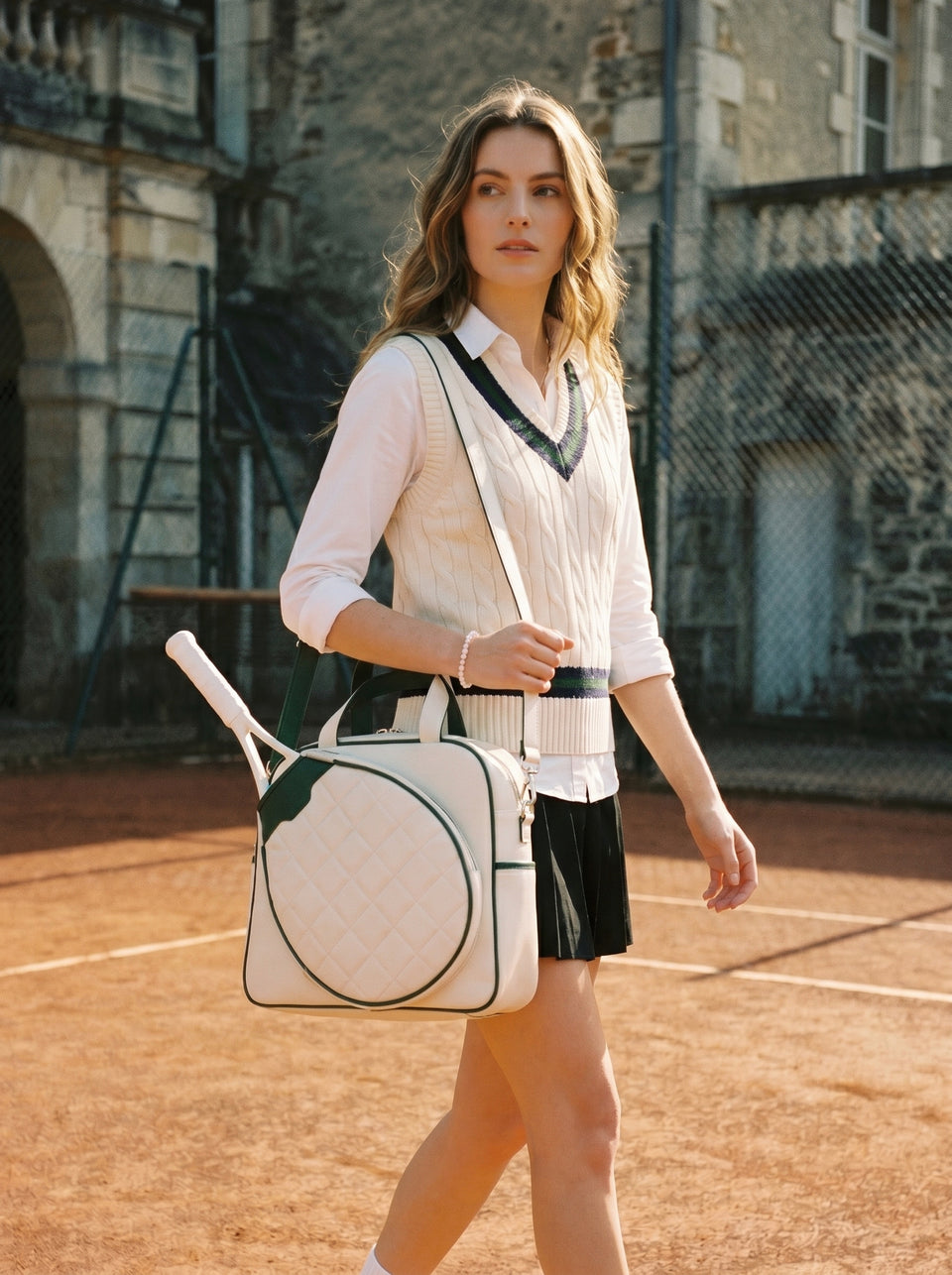
Its dedicated side shoe compartment keeps footwear separate. An exterior water and umbrella pocket and a secure back zipper pocket give everyday essentials their own places. At 25 litres and 0.75 kg empty, it offers a concrete set of specifications to compare alongside the carrying options.
For a court day that continues into other plans, those practical details sit within an understated everyday shape. Explore the Westmount's features and current availability to see how it fits your routine.
Make your choice with a two-line route note
Before choosing, write down your most demanding part of the journey and your most frequent stop. For example: “A short walk from the car; keys and water before the lesson,” or “A longer walk to the club; several flights of stairs.” These are example routines, not product tests.
Use the first line to compare carrying options, and the second to compare access and organisation. Once the format feels right, use our tennis bag size guide for the separate capacity decision, or our shoe-compartment guide for footwear organisation.
Cover: AI-generated editorial illustration of a court commute. Product photograph: Maison Muze. Read more in the Muze Journal.